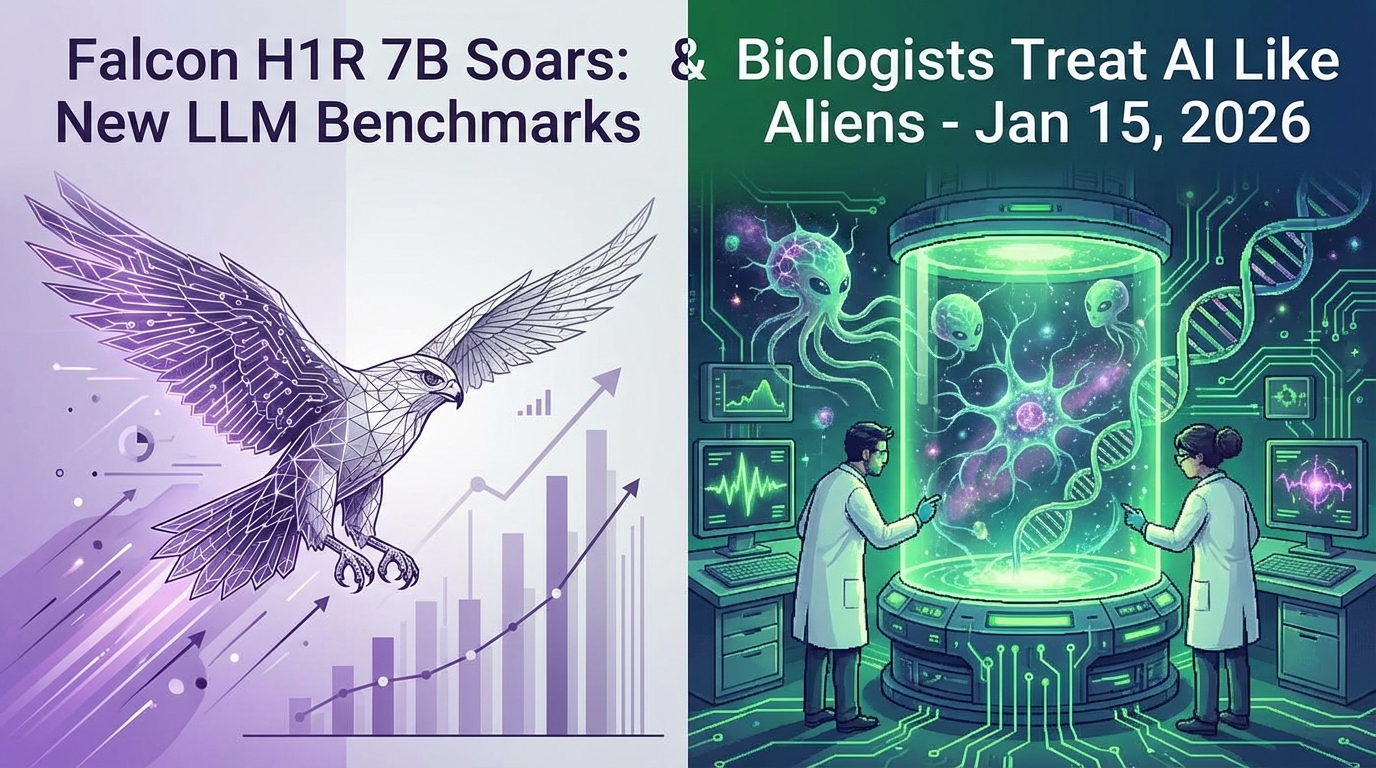
Falcon H1R 7B Soars: New LLM Benchmarks & Biologists Treat AI Like Aliens
Why This Matters
The relentless pace of innovation in large language models (LLMs) continues, driven by both architectural advancements and novel training methodologies. Today's developments highlight several key trends: the pursuit of efficient reasoning at smaller parameter sizes, the ongoing quest for reliable and objective benchmarks, and the emergence of unconventional approaches to understanding these complex systems. Falcon H1R 7B's impressive reasoning capabilities demonstrate that size isn't everything, potentially democratizing access to advanced AI. Simultaneously, the evolution of LLM benchmarks addresses critical concerns about data contamination and objective evaluation. And perhaps most intriguingly, treating LLMs as biological systems offers a fresh perspective on their inner workings, potentially unlocking new avenues for improvement and control. These advancements collectively shape the future of AI, impacting everything from enterprise applications to scientific discovery.
Viral AI Stories
- The "Alien Autopsy" of LLMs: A fascinating article in Technology Review details how biologists are approaching LLMs as living organisms, applying techniques like lesion studies to understand their internal mechanisms. This unconventional approach is generating surprising insights into how these models learn and reason.
- ChatGPT vs. the World: The debate continues regarding the best AI model for specific tasks. A popular Creator Economy post offers a practical guide to leveraging ChatGPT, Claude, and Gemini, sparking lively discussions about their respective strengths and weaknesses. The comparisons highlight the importance of choosing the right tool for the job.
LLM & Models Watch
- Falcon H1R 7B: A Reasoning Powerhouse: The Technology Innovation Institute (TII) has released Falcon H1R 7B, a 7 billion-parameter model optimized for reasoning tasks. Trained via supervised fine-tuning with long reasoning traces, Falcon H1R 7B achieves competitive reasoning performance while maintaining efficient inference. Its 256k context window is also notable, allowing it to process longer and more complex inputs. This is a significant achievement, demonstrating that smaller, more focused models can rival the performance of larger, more resource-intensive alternatives.
- Gemini 3.0 vs. the Titans: Comparisons between Gemini 3.0, GPT-5.1, Claude 4.5, and Grok 4.1 are intensifying, focusing on reasoning, coding, multimodality, and cost. While definitive conclusions remain elusive, these comparisons are essential for understanding the current state of the LLM landscape and identifying the optimal model for various applications.
- CALM: The Vector Prediction Revolution: The CALM architecture promises to accelerate LLM inference by predicting continuous vectors instead of individual tokens. This approach could significantly improve performance-compute trade-offs, paving the way for faster and more efficient LLM deployments. While still relatively new, CALM represents a potentially disruptive innovation in LLM architecture.
AI Agents & Tools Watch
- No specific AI Agents & Tools were mentioned in the provided context.
Global Signal
- The Benchmark Battleground: The need for robust and objective LLM benchmarks is more critical than ever. Traditional benchmarks are increasingly susceptible to data contamination, where models are inadvertently trained on data used in the benchmark itself. Initiatives like LiveBench are emerging to address this challenge, employing techniques like adversarial test set generation and objective evaluation metrics. The LLM Leaderboard by Vellum.ai and Artificial Analysis provide comparisons of over 100 models.
- LLMs as Infrastructure: LLMs are rapidly transitioning from research projects to essential components of product infrastructure. This shift necessitates a focus on scalability, reliability, and cost-effectiveness. As LLMs become more deeply integrated into everyday applications, their performance and efficiency will become even more critical.
What to Do Next
- Experiment with Falcon H1R 7B: Explore the capabilities of Falcon H1R 7B for reasoning-intensive tasks. Its smaller size and efficient inference make it an attractive option for resource-constrained environments. The model is available on Hugging Face, making it easy to integrate into existing workflows.
- Evaluate LLM Benchmarks Critically: Be aware of the limitations of existing LLM benchmarks. Consider the potential for data contamination and the relevance of the benchmark to your specific use case. Explore emerging benchmarks like LiveBench that prioritize objectivity and robustness.
- Consider Alternative Architectures: Keep an eye on emerging architectures like CALM that promise to improve LLM efficiency. While still in early stages, these innovations could significantly impact the future of LLM deployment.
- Contrarian View: While large context windows are generally seen as beneficial, consider the potential downsides. Do they truly enhance performance for all tasks, or do they introduce noise and increase computational costs without providing significant benefits? Focus on optimizing models for specific task requirements rather than blindly pursuing larger context windows.
- Watchlist:
- New LLM Architectures: Track the development of novel architectures like CALM and their impact on LLM performance and efficiency.
- Benchmark Innovations: Monitor the evolution of LLM benchmarks and the adoption of techniques that address data contamination and ensure objective evaluation.
- Biological Approaches to AI: Follow the progress of researchers who are applying biological methods to understand and improve LLMs.
Tags: #LLM #LargeLanguageModels #AI #ArtificialIntelligence #FalconH1R #Reasoning #Benchmarks #AIBenchmarks #Gemini #GPT5 #Claude #AIModels #MachineLearning #DeepLearning #AITools
Found this article helpful? Share it with others!
Quick AI FAQ
How does this AI development affect Malaysian businesses?
Local businesses can leverage these AI breakthroughs to automate repetitive tasks, improve customer engagement via smart chatbots, and scale content production with 80% lower costs.
Is it safe to integrate AI into existing workflows?
Yes, when implemented with professional oversight. We focus on secure, privacy-compliant AI integrations that align with Malaysia's PDPA regulations.
Where can I get help with AI implementation in Penang?
JOeve Smart Solutions provides on-site and remote AI consultation for SMEs in Penang and across Malaysia, specializing in web apps, chatbots, and video automation.