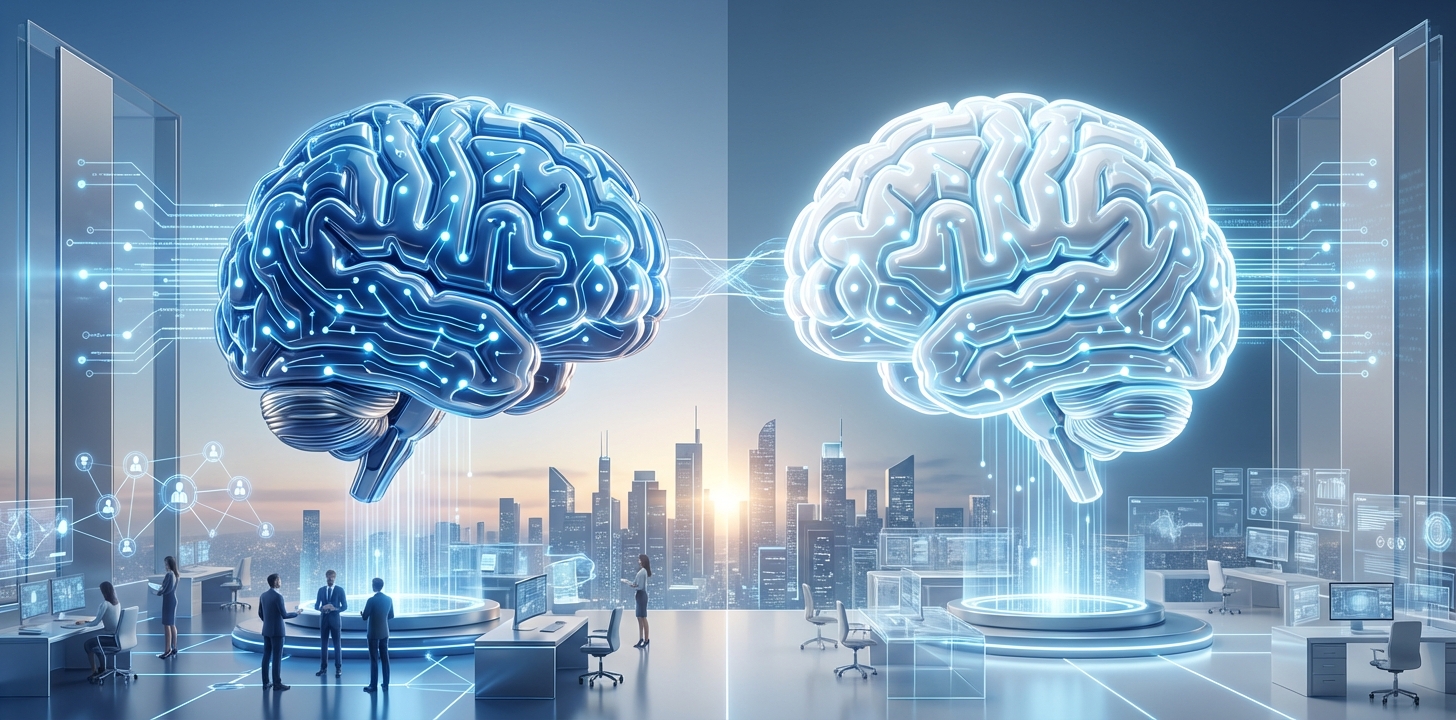
2026 AI Roadmap: How GPT-5 and Gemini 3 Are Redefining Reality

2026 AI Roadmap: How GPT-5 and Gemini 3 Are Redefining Reality
March 2026 has arrived, and the AI landscape is unrecognizable. From GPT-5’s dominance to the rise of SAM 3, here is why the "smartest" AI is just the beginning.
Imagine waking up, grabbing your coffee, and realizing your personal AI assistant didn't just organize your emails while you slept—it actually "watched" the video recording of your late-night brainstorming session, turned your messy whiteboard sketches into a functional prototype, and filed a patent draft before you even hit snooze.
This isn't a scene from a sci-fi movie. This is the reality of March 2026. We’ve officially moved past the era of "chatbots" and entered the era of true multimodal agents. If 2024 was about talking to AI, 2026 is about AI living alongside us, seeing what we see, and doing what we do. The jump in logic and reasoning we’ve seen in the last few weeks alone has made the models of 2024 look like pocket calculators. 🚀
Why This Matters
In plain English: we are reaching the "Intelligence Ceiling" of text-only models, and the industry is smashing through it with multimodal capabilities. Why should you care? Because the way you interact with technology is fundamentally shifting. You will no longer "prompt" an AI with complex text; you will simply show it a problem through your camera or share a complex data stream, and it will understand the context instantly. [9]
This matters for your job, your business, and your daily life because the "barrier to entry" for complex tasks has vanished. High-level coding, architectural design, and deep data analysis are now accessible to anyone with a smartphone. However, this rapid advancement also means that the hardware we use is struggling to keep up, forcing a massive rethink of how we build the very chips that power our world. [3]
Finally, the accuracy of these models has reached a tipping point. We are seeing GPT-4.5.5 and its competitors handle cultural nuances and idioms in languages like Spanish with a level of sophistication that was previously impossible. [2] This isn't just about translation; it's about cultural intelligence.
The Big Story
The headline news this month is the release of the "Frontier Benchmarks" for 2026. For the last year, the AI world felt somewhat stable, but that peace was shattered last week by a wave of new releases from OpenAI and Google. [4] According to the latest data from Epoch AI and Scale AI, we are seeing a "vertical take-off" in model performance across coding, math, and vision tasks. [1]
But here’s the twist: while the big companies are bragging about their scores, some experts are calling foul. A growing movement in the research community suggests that AI benchmarks are being hampered by "bad science." [6] The concern is that models are being trained specifically to pass these tests (a phenomenon called "data contamination"), making them look smarter on paper than they actually are in real-world scenarios.
Despite the controversy, the performance gap between the top three models—GPT-5, Claude 4 Opus, and Gemini 3—has never been tighter. We are seeing a fierce battle for the title of "Best Multimodal Model," with Meta’s SAM 3 (Segment Anything Model) making massive waves in the computer vision space. [10] Think of it like a decathlon where every athlete is breaking a world record simultaneously.
| Model | Key Strength | Best Use Case |
|---|---|---|
| GPT-5 | Reasoning & Logic | Complex problem solving & Agents |
| Claude 4 Opus | Nuance & Safety | Creative writing & Legal analysis |
| Gemini 3 | Multimodal Integration | Video analysis & Google Ecosystem |
| Llama 4 (Open) | Efficiency | Self-hosted & Private data |
| US Watch | ||
| In the United States, the focus has shifted from "Can we build it?" to "Can we power it?" The White House and various regulatory bodies are closely watching the hardware bottleneck. A recent breakthrough in hardware architecture is being hailed as the only way to sustain the growth of these Large Language Models (LLMs) without collapsing the power grid. [3] ⚡ | ||
| OpenAI and Microsoft are doubling down on their "Agentic" roadmap. They aren't just giving you a window to type in; they are building "Operating System AI" where the model has permission to move files, book flights, and manage your calendar across different apps. Meanwhile, Google is integrating Gemini 3 deeper into the Android kernel, making AI a native part of the hardware rather than just an app you open. | ||
| Wait, what? There's a catch. US regulators are now debating "Proof of Humanity" laws. As AI models become indistinguishable from humans in text and voice, the US government is considering a mandate that all AI-generated content carry a permanent, un-erasable digital watermark to prevent mass-scale misinformation. | ||
| China Watch | ||
| While the US is focused on raw power and integration, China is winning the "Efficiency War." Chinese tech giants like Alibaba and Tencent are releasing models that perform at 90% of GPT-5's level but at 20% of the energy cost. This is a strategic move to bypass the high-end GPU sanctions by making smarter software that doesn't need the latest NVIDIA chips to run. 🇨🇳 | ||
| China's multimodal models are also leading the way in industrial applications. They are using models like "Qwen-Vision" to automate entire factory floors, where the AI "sees" defects in real-time on a micro-scale that human eyes would miss. The goal in Beijing is clear: AI isn't just for chatting; it's for the physical rejuvenation of the manufacturing sector. | ||
| Global Signal | ||
| Worldwide, the "Open Source" movement is the real underdog story of 2026. For a while, people thought the big tech companies would have a permanent monopoly on intelligence. But the latest open-source LLM updates show that the community is catching up fast. [12] Developers are now able to run highly capable, private models on local hardware, which is a massive win for data privacy. [11] |
"The architecture of today's LLM applications has moved beyond simple prompts. We are now building entire ecosystems where the AI is the central nervous system of the business." — GitHub AI Research Lead [13]
Fun Fact: Did you know that by March 2026, AI models are now consuming more "synthetic data" (data created by other AIs) than human-generated data? We are officially teaching the machines using their own homework! 🤖
Malaysia Watch
In Malaysia, the "AI Rakyat" initiative is gaining massive momentum. Local startups are leveraging the new multimodal capabilities to bridge the language gap in rural areas. Imagine a farmer in Kelantan being able to point their phone at a diseased crop and receive an instant diagnosis in local dialect, powered by a localized version of an open-source model like Llama 4.
The opportunity for Malaysia lies in becoming the "AI Hub of Southeast Asia." With the recent investments in data centers in Johor and Cyberjaya, Malaysia is perfectly positioned to host the massive inference farms needed for these 2026-era models. For local businesses, the message is clear: don't just use AI; build your own "wrapper" around these models that understands the unique cultural and linguistic nuances of the Malaysian market. 🇲🇾
What to Do Next
- Audit Your Workflow: Look for tasks that involve "looking" and "doing," not just writing. With models like SAM 3 and Gemini 3, you can automate visual inspections and complex data entry. [10]
- Explore Open Source: If you are worried about data privacy, check out the latest open-source models that can be self-hosted. They are now genuinely competitive with the giants. [11]
- Don't Trust Every Benchmark: When a company claims their AI is "the smartest ever," look for real-world testing. Benchmarks are currently facing a "bad science" crisis. <mcre
Found this article helpful? Share it with others!
Quick AI FAQ
How does this AI development affect Malaysian businesses?
Local businesses can leverage these AI breakthroughs to automate repetitive tasks, improve customer engagement via smart chatbots, and scale content production with 80% lower costs.
Is it safe to integrate AI into existing workflows?
Yes, when implemented with professional oversight. We focus on secure, privacy-compliant AI integrations that align with Malaysia's PDPA regulations.
Where can I get help with AI implementation in Penang?
JOeve Smart Solutions provides on-site and remote AI consultation for SMEs in Penang and across Malaysia, specializing in web apps, chatbots, and video automation.