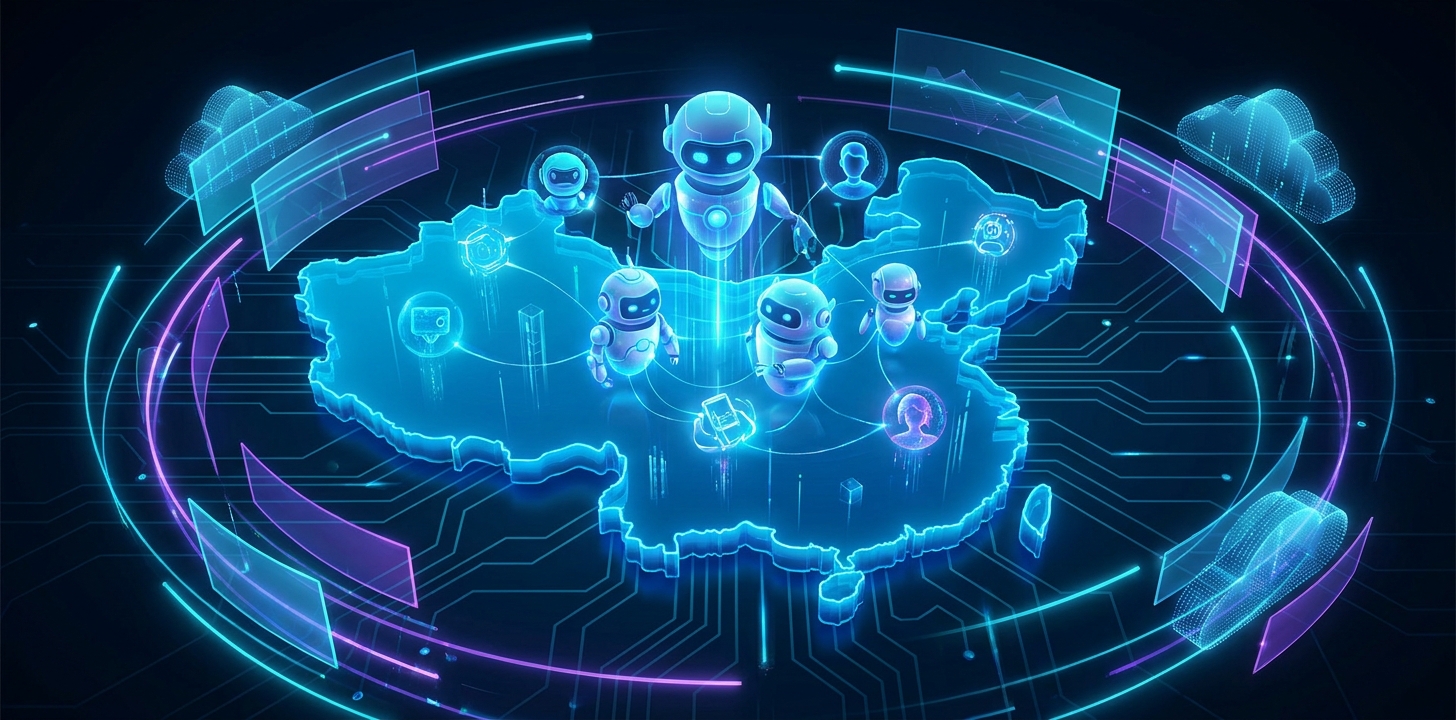
The 2026 AI Shift: How DeepSeek V4 and Kung Fu Robots Are Winning

The 2026 AI Shift: How DeepSeek V4 and Kung Fu Robots Are Winning
China’s AI blitz is here. From DeepSeek’s V4 to humanoid robots doing kung fu, the 2026 landscape is shifting fast. Here is why Silicon Valley is sweating.
Imagine sitting down for your morning coffee and seeing a humanoid robot on live television performing a flawless, high-speed kung fu routine. It’s not a scene from a sci-fi flick; it’s the 2026 Lunar New Year reality. While we were all busy arguing over which chatbot writes the best poetry, the global AI landscape underwent a seismic shift that caught most of the Western world off guard.
A year ago, a little-known company called DeepSeek sent shockwaves through Silicon Valley by proving you could build world-class AI for a fraction of the cost. Today, that "shock" has turned into a permanent state of play. We aren't just looking at smarter chatbots anymore; we are looking at a future where AI is "brain-like," robots are mass-produced like smartphones, and the very definition of tech dominance is being rewritten in real-time. 🤖
Why This Matters
In plain English: the "moat" around American AI dominance is evaporating. For years, the narrative was that China could only copy, not innovate. That narrative died in 2025 and was buried in 2026. 🪦
Why should you care? Because when AI becomes 100 times faster and significantly cheaper to run, it stops being a luxury tool for tech bros and starts being the engine behind everything you touch. We’re talking about your doctor’s diagnostic tools, your car’s self-driving brain, and the robots that might eventually deliver your groceries.
If one side of the world figures out how to make this tech for 1/10th of the price, the global economy shifts. It’s the difference between AI being a "Rolls Royce" that only elite companies can afford and AI being a "Honda Civic" that sits in every driveway. 🚗
The Big Story
The headline grabber for 2026 is undoubtedly the "Spring Festival Flurry." Just as the world prepared for the Lunar New Year, China’s tech titans—DeepSeek, Alibaba, ByteDance, and Tencent—unleashed a coordinated wave of new models [3].
DeepSeek is the name on everyone’s lips. Their upcoming V4 model is expected to double down on the "open-weight" strategy that made them famous [2]. Think of "open-weight" like a secret recipe that a chef shares with the world; anyone can use it, tweak it, and improve it. This strategy is gaining massive global traction because it breaks the monopoly of closed-source giants like OpenAI.
Wait, what? It gets weirder. Chinese scientists just announced a "brain-like" AI model that is reportedly 100 times faster than current Large Language Models (LLMs) [5]. Instead of just processing text through brute force and massive energy consumption, this model mimics the efficiency of the human brain. If this holds up, the energy crisis sparked by AI data centers might just have found its solution.
| Feature | US Giants (Closed Source) | China’s New Wave (Open/Efficient) |
|---|---|---|
| Cost to Train | Billions of Dollars | Millions of Dollars |
| Hardware | High-end Nvidia H100s/B200s | Optimized for restricted/older chips |
| Strategy | Subscription/API Access | Open-weight/Infrastructure integration |
| Focus | General Intelligence (AGI) | Agentic AI & Efficiency |
| US Watch | ||
| In the United States, the mood is a mix of panic and "I told you so." A recent report highlights a stinging irony: the U.S. actually trained many of the researchers who are now leading China’s AI breakthroughs [6]. We exported the knowledge, and now that knowledge is coming back as fierce competition. | ||
| The U.S. government has doubled down on chip restrictions, trying to starve Chinese firms of the high-end Nvidia chips needed for AI. However, this has backfired in a way no one expected. Instead of quitting, Chinese engineers became masters of efficiency. They learned to do with "scraps" what American companies do with a buffet. | ||
| Silicon Valley is now watching Nvidia’s stock price nervously. If Chinese companies continue to prove they don't need the latest $40,000 chips to build world-class AI, the massive hardware moat protecting US tech dominance might just be made of sand. 🏜️ | ||
| China Watch | ||
| The sheer scale of investment in China is staggering. Alibaba, Tencent, and ByteDance are projected to pour a combined $84 billion into AI infrastructure by 2027 [9]. That’s not just "software" money; that’s "building-new-cities" money. | ||
| But it’s not all smooth sailing. The market is volatile. Alibaba and Tencent recently saw $66 billion in market value evaporate in a single day as investors fretted over whether these massive AI investments would actually pay off in the short term [7]. 📉 | ||
| The real "cool factor," though, is in the hardware. Unitree, a Chinese robotics startup, is moving from viral videos of robots falling over to shipping 10,000 to 20,000 humanoid units in 2026 [11]. These robots aren't just doing kung fu for show; they are being prepared for factory floors and domestic help. | ||
| Global Signal | ||
| What does this mean for the rest of us? We are entering the era of "Agentic AI." This is the shift from an AI you talk to to an AI that does things for you. Tencent and Alibaba are currently in a high-stakes race to see who can build the best "AI Agents"—digital assistants that can book your flights, manage your calendar, and even handle your online shopping without you lifting a finger [8]. | ||
| The global signal is clear: AI is becoming a commodity. When the cost of intelligence drops to near zero, the value moves from the model to the application. |
"China is now the global leader in AI research publications and is neck and neck with the United States on generative AI," says a report from the ITIF [12].
The world is no longer a one-horse race. This competition will likely drive down prices for consumers everywhere, but it also raises massive questions about data privacy and the future of work. 🌍
Malaysia Watch
For Malaysia, this 2026 AI surge is a golden ticket. As the "Silicon Valley of the East," Malaysia is perfectly positioned to be the neutral ground where Eastern and Western AI technologies meet. 🇲🇾
With the massive $84 billion infrastructure spend coming from Chinese tech giants, Malaysia’s data center industry is set for a historic boom. We aren't just hosting servers; we are hosting the brains of the next generation. Local startups now have access to powerful, low-cost open-weight models from DeepSeek and Alibaba, allowing Malaysian entrepreneurs to build "Agentic AI" solutions tailored for the Southeast Asian market.
Think of it this way: If a small business in Kuala Lumpur can use a world-class AI model for pennies to automate their logistics, that business can suddenly compete on a global stage. The opportunity isn't just in building the AI, but in using it to supercharge our local industries.
What to Do Next
- Experiment with Open-Weight Models: Don't just stick to ChatGPT. Try out DeepSeek or Alibaba’s Qwen models. They are often just as capable and much cheaper for developers.
- Focus on "Agents," Not Just "Chat": Start looking for tools that automate tasks rather than just generating text. The future is in AI that acts, not just talks.
- Upskill for the Robotics Era: With 20,000 humanoid robots shipping this year, the demand for people who can maintain, program, and manage these machines is about to skyrocket. 🛠️
- Watch the Efficiency Metrics: When choosing AI tools for your business, don't just look at "smartness." Look at "tokens per dollar." In 2026, efficiency is the new king.
TL;DR - China’s AI Blitz: DeepSeek, Alibaba, and Tencent released a flurry of low-cost, high-efficiency models in early 2026, challenging US dominance.
- Brain-Like Breakthrough: Chinese scientists claim a new AI model 100x faster than traditional LLMs, potentially solving AI's massive energy problem.
- Robot Revolution: Humanoid robots (like Unitree) are moving from viral stunts to mass production, with 20,000 units expected to ship this year.
- The Bottom Line: AI is becoming cheaper and more "agentic," shifting the focus from how smart an AI is to how much work it can actually do for you.
#AI #LLM #AIAgents #AITools #ChinaAI #USAi #DeepSeek #Robotics #TechNews2026 #FutureOfWork #AIInnovation #AlibabaAI #TencentAI #HumanoidRobots
Found this article helpful? Share it with others!
Quick AI FAQ
How does this AI development affect Malaysian businesses?
Local businesses can leverage these AI breakthroughs to automate repetitive tasks, improve customer engagement via smart chatbots, and scale content production with 80% lower costs.
Is it safe to integrate AI into existing workflows?
Yes, when implemented with professional oversight. We focus on secure, privacy-compliant AI integrations that align with Malaysia's PDPA regulations.
Where can I get help with AI implementation in Penang?
JOeve Smart Solutions provides on-site and remote AI consultation for SMEs in Penang and across Malaysia, specializing in web apps, chatbots, and video automation.