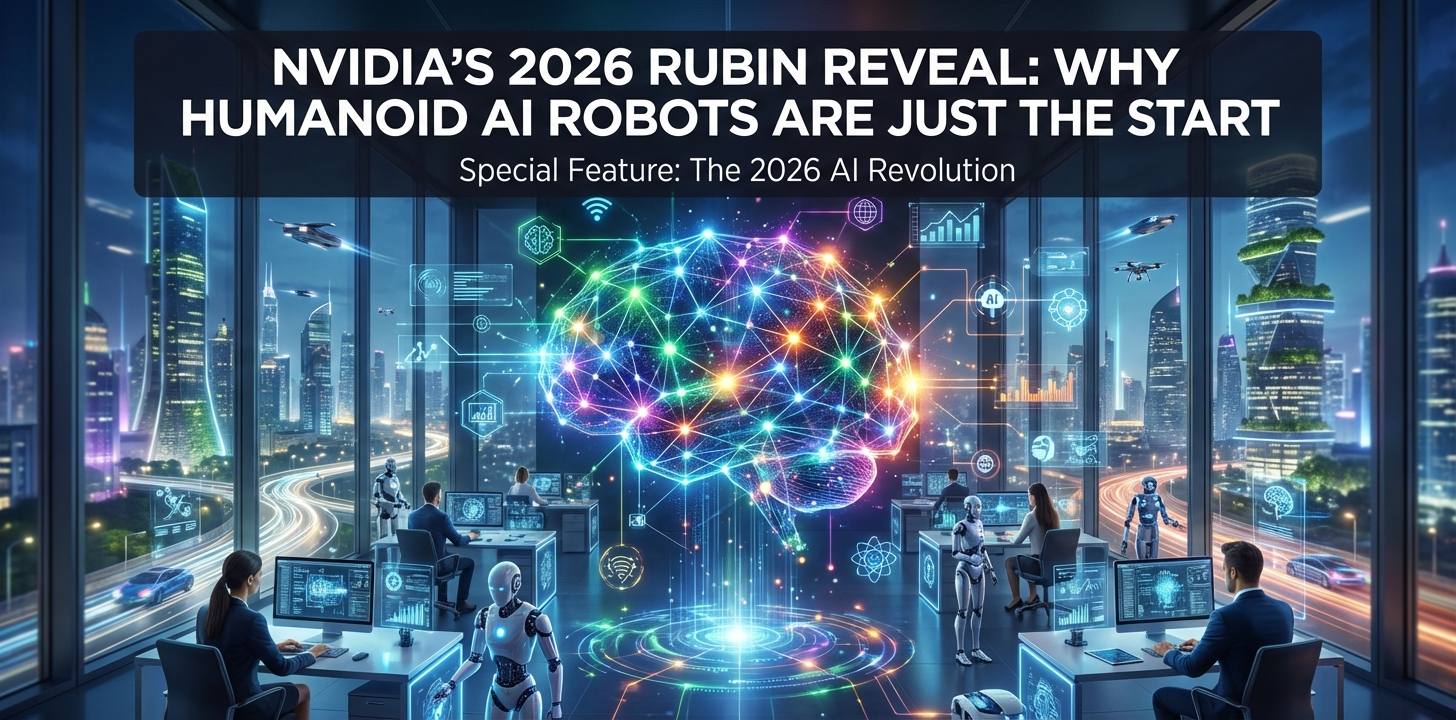
NVIDIA’s 2026 Rubin Reveal: Why Humanoid AI Robots Are Just the Start
Opening Hook
Imagine waking up in late 2026. You walk into your kitchen, and your countertop robot—a sleek, humanoid assistant—is expertly folding your laundry while simultaneously optimizing your small business’s supply chain on a virtual screen. 🤖
This isn't a scene from a sci-fi movie; it’s the world NVIDIA and the global tech industry are building right now. We’ve spent the last few years chatting with AI in little boxes on our screens, but the "Ghost in the Machine" is finally getting out. Between the announcement of the massive "Rubin" chip architecture and robots that can finally pour a perfect latte, the jump from 2025 to 2026 is looking like the biggest leap in human productivity since the steam engine.
Wait, what? A robot that folds laundry? I can barely get my teenager to do that. But as we’re seeing in the latest breakthroughs, the "Agentic AI" revolution—where AI doesn't just talk, but acts—is officially here. 🚀
Why This Matters
In plain English: We are moving from "Generative AI" (AI that makes things) to "Agentic AI" (AI that does things). 🛠️
For the average person, this means the end of "busy work." Instead of you spending hours figuring out how to automate your spreadsheet, an AI agent will simply see the task, understand the goal, and execute it across multiple apps without you lifting a finger.
The hardware news today—like NVIDIA's Rubin platform—is the "engine" that makes these agents fast enough to react in real-time. Without these massive chips, a humanoid robot would be too slow to catch a falling glass or react to a change in a factory line. By 2026, the speed of AI will finally match the speed of human thought—and eventually, surpass it. [1]
The Big Story
The headline grabber is undoubtedly NVIDIA's Rubin platform. CEO Jensen Huang has officially kicked off the next generation of AI supercomputing, promising that Rubin-based systems will be integrated into major cloud platforms like CoreWeave by the second half of 2026. [1]
But what is Rubin? Think of it as the ultimate brain transplant for the internet. While the current "Blackwell" chips are impressive, Rubin is designed to handle the sheer complexity of "Agentic" workflows—where thousands of AI agents are all talking to each other at once to solve a single problem.
Nvidia is also reportedly working on a specific, new processor designed to help OpenAI and other giants build even faster, more efficient systems by 2026. [2] This isn't just about making ChatGPT smarter; it's about making it instant.
Rubin vs. Previous Tech: What’s the Difference?
| Feature | Blackwell (Current) | Rubin (2026) |
|---|---|---|
| Primary Focus | Large Language Models | Autonomous Agents & 6G |
| Efficiency | High | Ultra-High (Lower Power) |
| Connectivity | Standard AI Networking | Integrated 6G & Edge Ready |
| Target Users | Data Centers | Humanoids, Edge, & Clouds |
| However, here’s the contrarian take: while everyone is obsessed with GPUs (Graphics Processing Units), some experts are noticing that CPUs (Central Processing Units) are actually making a massive comeback in data centers. [9] Why? Because as AI workloads become more diverse, we need "all-rounder" chips to handle the mundane tasks that keep the AI running. It turns out, even a super-intelligent AI needs a basic "utility" brain to keep the lights on. |
US Watch
The United States is currently the playground for the "Humanoid Robot" summer. At a recent Silicon Valley summit, the tech world was buzzing as small robots roamed the halls, pouring lattes and—the holy grail of robotics—attempting to fold clothes. [5] 👔
While it sounds funny, folding a soft, unpredictable piece of fabric is actually one of the hardest things for a robot to do. It requires "spatial intelligence"—the same kind of AI that NVIDIA’s new chips are designed to accelerate.
The US focus isn't just on the robots themselves, but on the Agentic Software that lives inside them. Companies are racing to create "General Purpose" robot brains. Instead of a robot that only knows how to weld, we are seeing the birth of robots that can be "told" how to perform a new task just by watching a human do it. [4]
China Watch
While the US focuses on lattes and laundry, China is doubling down on AI-integrated manufacturing. The focus here is on "Customized Production." [12] 🏭
Imagine a factory where the assembly line changes itself in real-time based on what customers are ordering on an app. AI-enhanced robotic arms in Chinese factories are now being outfitted with advanced sensors and computer vision that allow them to identify defects instantly and adapt to different materials without a human technician needing to reprogram them. [13]
Did you know?
Humanoid robots are expected to fill a labor gap in manufacturing that could reach millions of workers by 2030. China is currently leading the world in the sheer volume of industrial robot installations. 🤖
Global Signal
The world is about to get a lot more "Quantum." Google and other researchers are reporting massive strides in Quantum AI. [7]
Why does this matter? Because current AI uses a massive amount of electricity. Quantum computers could potentially drive AI to new heights of accuracy while being significantly more sustainable. [8] Nature recently highlighted how AI is being used to actually build better quantum computers, creating a "virtuous cycle" where AI builds the machine that makes it smarter. [6] 🌀
Furthermore, NVIDIA’s Jensen Huang is already looking past 5G. He’s arguing that 6G telecommunications should be built on an "AI-first" open-source foundation. [10] This would mean your phone isn't just connected to the internet; it’s part of a global AI neural network that processes data at the "edge"—meaning right there in your hand, rather than in a far-off data center. [11]
Malaysia Watch
So, what does this mean for Malaysia? 🇲🇾
As a global hub for semiconductor packaging and testing, Malaysia sits in a "goldilocks" zone. The shift toward the Rubin architecture and AI-integrated 6G infrastructure presents a massive opportunity for the Malaysian tech sector.
- Data Center Boom: With companies like CoreWeave integrating Rubin chips in 2026, the demand for high-tech data centers in regions like Johor and Cyberjaya will skyrocket.
- Manufacturing 4.0: Malaysian electronics factories in Penang can leverage these AI-enhanced robotic arms to move up the value chain, shifting from "assembly" to "intelligent, customized production." [12]
- Local Talent: There is a growing need for "AI Orchestrators"—people who don't just code, but know how to manage a fleet of AI agents in a business environment.
What to Do Next
The 2026 "Agentic Shift" is coming fast. Here is how you can stay ahead:
- Audit Your "Busy Work": Identify tasks you do daily that require switching between 3 or more apps. These are the first tasks that AI Agents will take over in 2026. Start looking for "agentic" tools now. 🖱️
- Invest in "Spatial Literacy": If you are in manufacturing or logistics, start researching how AI computer vision integrates with your current hardware. The "Rubin" era will make these upgrades much cheaper. 👁️
- Keep an Eye on 6G: As NVIDIA pushes for AI-driven 6G, start thinking about how "Edge Computing" (processing data locally) could benefit your privacy and speed.
- Don't Fear the Robot: Humanoid robots are coming for the "3 D's": Dull, Dirty, and Dangerous jobs. Focus your skills on high-level strategy and human empathy—things AI still struggles with. 🤝
TL;DR
- NVIDIA Rubin: A new super-chip platform arriving in 2026 designed to power autonomous AI agents and 6G networks. ⚡
- Humanoid Breakthroughs: Robots are moving from factories to lattes, learning to navigate the physical world using "spatial intelligence." 🤖
- Quantum Boost: Quantum computing is beginning to "supercharge" AI accuracy and sustainability. 🌀
- Hardware Shift: While GPUs are king, CPUs and "Edge" devices are becoming essential for the massive infrastructure buildout ahead
Found this article helpful? Share it with others!
Quick AI FAQ
How does this AI development affect Malaysian businesses?
Local businesses can leverage these AI breakthroughs to automate repetitive tasks, improve customer engagement via smart chatbots, and scale content production with 80% lower costs.
Is it safe to integrate AI into existing workflows?
Yes, when implemented with professional oversight. We focus on secure, privacy-compliant AI integrations that align with Malaysia's PDPA regulations.
Where can I get help with AI implementation in Penang?
JOeve Smart Solutions provides on-site and remote AI consultation for SMEs in Penang and across Malaysia, specializing in web apps, chatbots, and video automation.