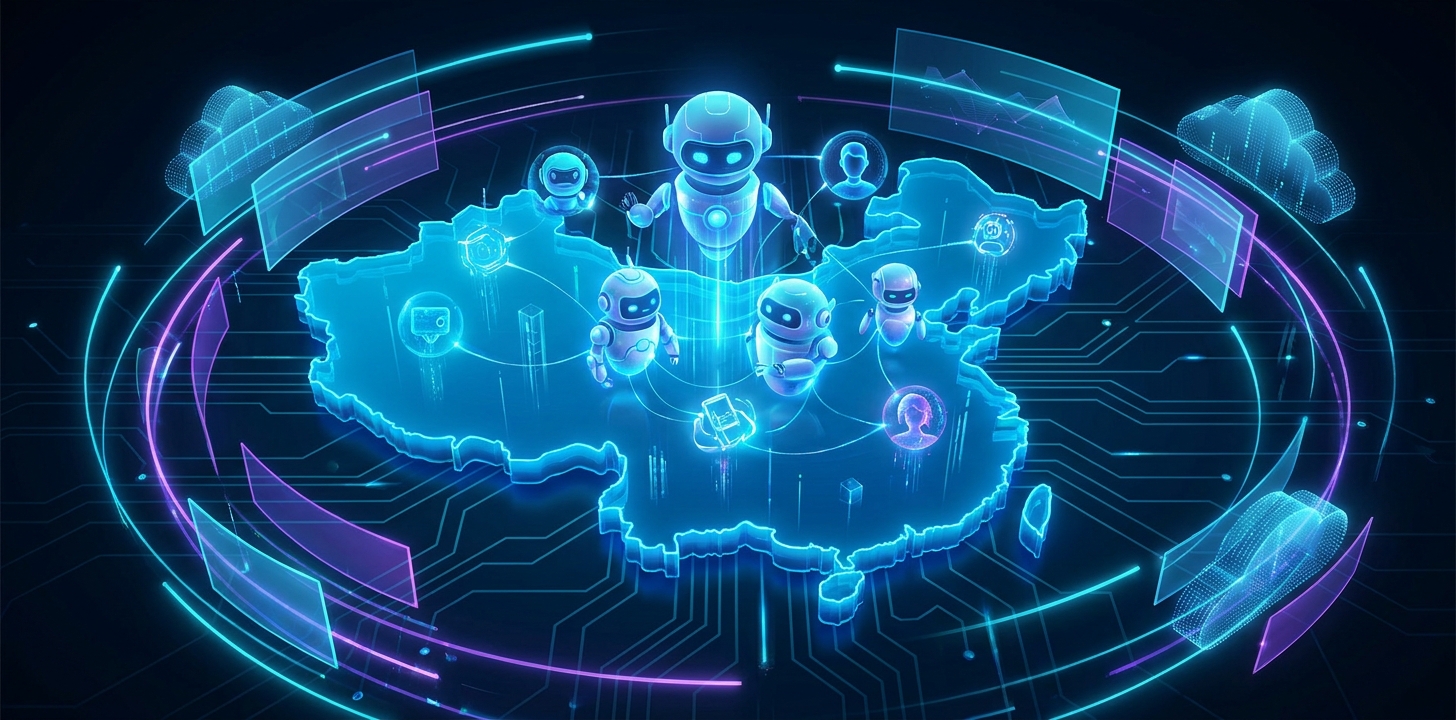
Shocking 2026 Breakthrough: China’s AI Surge Reveals a New Global Era
Shocking 2026 Breakthrough: China’s AI Surge Reveals a New Global Era
Imagine sitting down for your Chinese New Year reunion dinner in February 2026. Instead of a frazzled waiter, a sleek, humanoid robot glides to your table, pours your tea with perfect precision, and cracks a joke about the Year of the Horse in your local dialect. This isn't a scene from a sci-fi movie; it was the reality across millions of screens and thousands of venues during the 2026 Spring Festival as China’s humanoid robot industry took center stage [10].
Wait, what? Just a couple of years ago, we were worried if AI could even draw hands correctly. Now, we are seeing a massive "DeepSeek Moment" anniversary where the world realizes that the AI race isn't just about who has the biggest supercomputer, but who can make AI the most accessible, affordable, and integrated into our physical lives [2]. The landscape has shifted, and if you aren't paying attention to the flurry of low-cost models flooding the market right now, you’re already behind.
Why This Matters
In plain English: AI is getting dirt cheap and incredibly fast. For the average person, this means the "God-like" intelligence we used to pay $20 a month for is becoming a free, built-in feature of every app you own. We are moving away from "talking to a chatbot" and moving toward "AI agents" that actually do your chores, manage your schedule, and even manufacture the goods you buy.
This matters because the "tech war" isn't just a headline for billionaires; it’s a battle over whose brain—Silicon Valley’s or Beijing’s—will power your future smart home and your workplace. When China releases a flurry of low-cost models, it forces the entire world to lower prices [3]. It’s like the early days of the smartphone—suddenly, everyone has a supercomputer in their pocket, but this time, the computer can think for itself.
Furthermore, the "EV playbook" is being applied to robotics. Remember how Chinese electric vehicles suddenly became high-quality and affordable, disrupting the entire car industry? That is exactly what is happening with humanoid robots right now. China now controls a staggering 90% of the global humanoid robot market [11]. This means the robot that eventually mows your lawn or helps your elderly parents will likely be born from this current technological surge.
The Big Story
The headline story of 2026 is the sheer scale of China's AI commercialization. While the West focused on massive, power-hungry models, Chinese tech titans like Baidu, Alibaba, and Tencent pivoted to "efficiency." One year after the "DeepSeek Shock" first sent ripples through the industry, the market is being hit by a wave of hyper-efficient models that provide 90% of the performance of top-tier US models at a fraction of the cost [3].
ByteDance, the parent company of TikTok, has emerged as a massive player in this space. Their Doubao chatbot has officially become China’s most popular AI app, boasting an incredible 155.2 million weekly active users [3]. Think of it like this: nearly half the population of the United States is using one single Chinese AI app every single week. That is a level of data and user feedback that most Western companies can only dream of.
But it’s not just software. Alibaba and Baidu are putting their money where their mouths are—literally. These giants have gone on a massive fundraising spree, tapping bond markets to fuel a capital expenditure that could top $32 billion in 2025 and 2026 [9]. They aren't just building "chatbots"; they are building the physical infrastructure—the chips and the servers—to ensure they don't have to rely on anyone else.
"China's tech innovation is poised for policy-driven growth in 2026, with AI placed at the center of the country's economic agenda," notes a recent industry analysis [1].
Here is a quick look at how the major players are stacking up in the 2026 landscape:
Company Key Strength 2026 Milestone ByteDance Consumer Reach Doubao hits 155M weekly users [3] Alibaba Infrastructure New AI chips and Qwen model upgrades [6] Baidu Ecosystem Stock surged 15.7% after major AI manufacturing breakthroughs [7] Unitree Robotics Dominating the humanoid market with high-speed mass production [11] US Watch In the United States, the mood is one of "strategic recalibration." For years, the US held an undisputed lead in AI, but recent breakthroughs in China are putting that dominance at risk [4]. The US response has been to double down on high-end compute and generative video—think OpenAI’s Sora and its successors. However, the "DeepSeek Shock" taught US tech leaders a hard lesson: you don't always need the most expensive chips to win the race. US companies are now racing to see if they can match the cost-efficiency of Chinese models. We are seeing a shift from "Who can build the biggest model?" to "Who can build the most useful model that doesn't cost a fortune to run?" There is also a growing concern about the "Humanoid Gap." While Tesla’s Optimus remains a high-profile project, the sheer manufacturing speed in China is hard to ignore. If China continues to control 90% of the robot market, the US may find itself in a position where it designs the "brains" of the robots, but China builds the "bodies" [11]. China Watch The story in China is one of relentless, policy-driven momentum. The government has placed AI at the very center of its economic agenda for 2026 [1]. This isn't just about fun apps; it’s about upgrading the entire nation’s manufacturing capabilities. Breakthroughs from companies like MiniMax and Zhipu AI are no longer surprises—they are expected results of years of national strategy [5]. By March 2026, Chinese firms had launched video-generation tools that rival anything coming out of Silicon Valley [13]. The most "Wait, what?" moment for many observers has been the rise of companies like MetaX and Moore Threads. These aren't household names yet in the West, but global investors are pouring money into them as they bet on China’s ability to build its own semiconductor ecosystem to bypass Western export controls [8]. Global Signal What does this mean for the rest of the world? We are entering a "Multi-Polar AI Era." Instead of one single standard, we are seeing multiple AI races happening at once [12]. One race is for "Frontier Intelligence" (the smartest AI), another is for "Efficiency" (the cheapest AI), and a third is for "Physical Agency" (robotics). This global competition is driving down the cost of intelligence everywhere. For developing nations, this is a goldmine. They no longer have to wait for expensive Western technology to trickle down; they can adopt high-performance, low-cost Chinese models to digitize their economies today. Fun Fact: By mid-2026, the cost to train a basic LLM has dropped by nearly 70% compared to 2024, largely due to architectural efficiencies pioneered during the "DeepSeek" era <mcreference link="https://money.usnews.com/investing/news/articles/2026-02-12/a-year-on-from-deep
Found this article helpful? Share it with others!
Quick AI FAQ
How does this AI development affect Malaysian businesses?
Local businesses can leverage these AI breakthroughs to automate repetitive tasks, improve customer engagement via smart chatbots, and scale content production with 80% lower costs.
Is it safe to integrate AI into existing workflows?
Yes, when implemented with professional oversight. We focus on secure, privacy-compliant AI integrations that align with Malaysia's PDPA regulations.
Where can I get help with AI implementation in Penang?
JOeve Smart Solutions provides on-site and remote AI consultation for SMEs in Penang and across Malaysia, specializing in web apps, chatbots, and video automation.