2026 AI Roadmap: China’s Humanoid Surge and the US Defense Drama
2026 AI Roadmap: China’s Humanoid Surge and the US Defense Drama
As we move deeper into 2026, the AI world is starting to look less like a polite tech conference and more like a high-stakes spy thriller. Imagine working at Coca-Cola and suddenly walking into a courtroom to defend Pepsi. That is exactly the kind of "wait, what?" moment we are seeing in Silicon Valley right now.
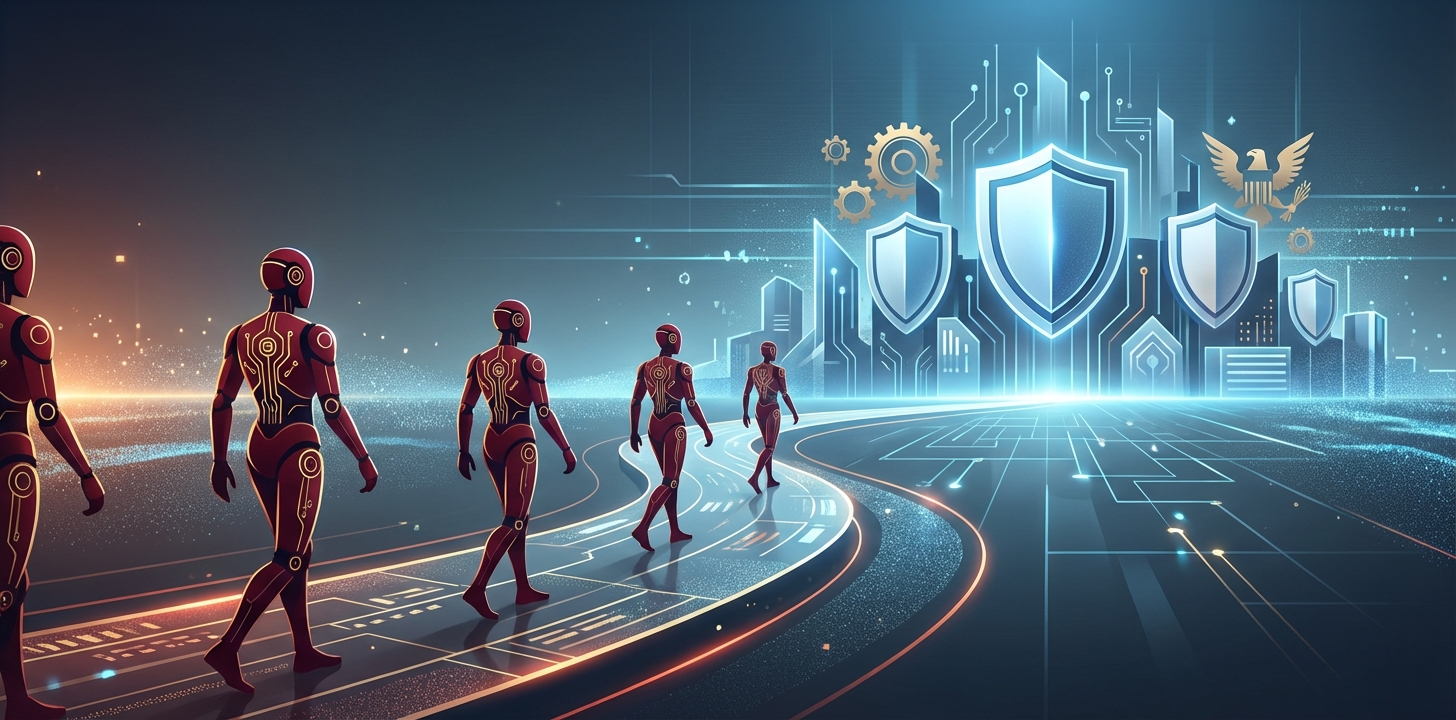
In a move that has stunned industry insiders, more than 30 employees from OpenAI and Google DeepMind have banded together. Their mission? To support their rival, Anthropic, in a massive legal battle against the U.S. Department of Defense (DoD) [1]. It seems the common enemy isn't the competition anymore—it’s the bureaucracy trying to control how AI is built.
Meanwhile, across the Pacific, the "Great AI Wall" is being replaced by a "Great AI Wave." China is no longer just trying to catch up; they are redesigning the entire race. From DeepSeek’s ultra-efficient models to a literal army of humanoid robots entering mass production in Shenzhen, the vibe of 2026 is clear: the hardware is finally catching up to the hype. 🤖
Why This Matters
This matters because we are officially entering the "Inference Era." For the last few years, everyone was obsessed with training AI—the digital equivalent of a student cramming for an exam. In 2026, the focus has shifted to inference, which is the AI actually doing the work, making decisions, and powering robots in real-time.
By the end of this year, inference workloads will account for a staggering two-thirds of all AI compute [11]. This means the companies that control the "gas stations" (data centers) and the "engines" (chips) will hold the keys to the global economy. If your favorite AI tool suddenly gets blocked by a government agency, or if a Chinese robot can suddenly fold your laundry better than you can, your daily life changes.
For the average person, this isn't just "tech talk." It’s about which country’s ethics are baked into the robot that might eventually care for your elderly parents or manage your bank account. The drama between the U.S. government and companies like Anthropic is essentially a fight over who gets to set the "rules of the road" for the next decade of human history.
The Big Story
The headline story of the week is the sudden "divorce" between Anthropic and the U.S. government. Three major cabinet-level agencies—State, Treasury, and Health and Human Services—have officially started phasing out Anthropic’s AI products [3]. They are pivoting back toward OpenAI and Google, creating a massive rift in the "Frontier Model" landscape.
Why the sudden cold shoulder? It boils down to a lawsuit Anthropic filed against the Defense Department regarding procurement contracts. While the government is pulling back, Google has clarified that while it won't use Anthropic for defense-specific projects, it is still making the technology available to its other commercial clients [2].
The most fascinating part is the solidarity from the "Big Three." When OpenAI and Google employees signed that statement supporting Anthropic, they sent a clear message: If the government can bully one of us over safety protocols or contract terms, they can bully all of us. It is a rare moment of "enemy of my enemy is my friend" in a cutthroat industry.
"To win, United States AI companies must be free to innovate without cumbersome regulation," states a recent federal policy framework [12].
But "freedom to innovate" is getting messy. We are seeing a total reshuffling of the deck. While the U.S. government argues with its own best tech companies, those companies are still raising billions. Waymo just secured a jaw-dropping $16 billion at a $126 billion valuation [19]. The money is there, but the political will is fractured.
US Watch
In the U.S., the big theme for 2026 is "Federal vs. State." It’s a classic American showdown. While all 50 states have introduced some form of AI legislation [15], the White House is pushing back. A late-2025 executive order specifically targets state-based AI regulations that might slow down national progress [13].
Think of it like this: California wants the AI car to have five different types of brakes, but the Federal government says that makes the car too slow to beat China. The Department of Justice is now tasked with hunting down state laws that "unconstitutionally regulate" AI [14]. It’s a regulatory tug-of-war where the rope is made of fiber-optic cables.
On the hardware side, Microsoft is preparing for the NVIDIA GTC 2026 conference (happening this March!) where they will showcase how AI is moving from "cool experiment" to "real-world tool" [8]. Microsoft is even rolling out its own custom chips to compete with NVIDIA, hoping to lower the massive costs of running these giant models [9].
China Watch
While the U.S. fights in courtrooms, China is fighting in the factories. The "Big Four" of China—DeepSeek, ByteDance, Alibaba, and Tencent—have shifted their strategy. Instead of just making "chatbots," they are building "world-simulators." 🇨🇳
- DeepSeek: They have become the efficiency kings. In 2026, DeepSeek’s latest models are reportedly matching GPT-5 levels of reasoning but using 40% less power. This is a massive deal in a world where electricity is the new gold.
- ByteDance: The owners of TikTok are using their massive video library to train "Physical AI." Their new models don't just generate videos; they understand how gravity and friction work, which is the secret sauce for robotics.
- Humanoid Robots: This is where it gets wild. Companies like Unitree and Fourier Intelligence are now mass-producing humanoid robots that cost less than a Tesla. These aren't just for viral videos anymore; they are being deployed in EV factories across China to handle repetitive assembly tasks.
- Baidu & Alibaba: Both are pivoting heavily toward "Agentic AI"—software that doesn't just talk to you but actually logs into your apps and does your work for you.
US vs. China Humanoid Progress (2026)Feature US (Tesla/Figure) China (Unitree/Fourier) Focus High-end dexterity & AI logic Mass production & low cost Estimated Price $50,000 - $100,000 $16,000 - $30,000 Key Advantage Superior "Brain" (LLM integration) Superior Supply Chain (Battery/Motors) Primary Use Luxury homes & specialized R&D Factory floors & logistics Global Signal The "Global Signal" for 2026 is that the AI race is no longer a winner-take-all game. We are seeing a "balkanization" of AI. The U.S. is leading in frontier research and high-end software, but China is dominating the physical manifestation of AI. 🌏 Did you know? In 2026, the energy consumption of AI data centers globally is projected to equal the entire power usage of Japan. This is why "efficiency" is the most important word in tech right now. The rest of the world is picking sides. Europe is leaning toward heavy regulation (and falling behind), while the Middle East is investing billions into "Sovereign AI" clouds to ensure
Found this article helpful? Share it with others!
Quick AI FAQ
How does this AI development affect Malaysian businesses?
Local businesses can leverage these AI breakthroughs to automate repetitive tasks, improve customer engagement via smart chatbots, and scale content production with 80% lower costs.
Is it safe to integrate AI into existing workflows?
Yes, when implemented with professional oversight. We focus on secure, privacy-compliant AI integrations that align with Malaysia's PDPA regulations.
Where can I get help with AI implementation in Penang?
JOeve Smart Solutions provides on-site and remote AI consultation for SMEs in Penang and across Malaysia, specializing in web apps, chatbots, and video automation.