2026 AI Breakdown: Anthropic’s $350B Bet and the Global Power Shift
2026 AI Breakdown: Anthropic’s $350B Bet and the Global Power Shift
Imagine a world where a single AI company consumes as much electricity as a small country. We aren't talking about a sci-fi movie set in the distant future; we are talking about the reality of 2026. The "compute wars" have moved from the basement to the power grid. While you were sleeping, the scale of artificial intelligence shifted from "millions of dollars" to "multiple gigawatts."
If you feel like the pace of AI is moving too fast to track, you’re not alone. But here’s the kicker: the "chatter" about chatbots is being replaced by the "clatter" of massive hardware infrastructure. The top players are no longer just fighting over who has the smartest assistant; they are fighting over who owns the most silicon and the most electricity. It is a digital arms race, and the stakes have never been higher. ⚡
Why This Matters
For the average person, this might seem like billionaire drama. But here is why it hits your front door: the cost of intelligence is dropping while the power required to generate it is skyrocketing. When companies like Anthropic or OpenAI secure "gigawatts" of power, they are essentially building the new "oil refineries" of the 21st century.
This matters because whoever wins this race dictates how your phone works, how your doctor diagnoses you, and how your children learn. If the US or China pulls ahead significantly, it changes the global economy overnight. We are moving away from "software as a service" to "intelligence as a utility." Just like you pay for water and electricity, in 2026, you'll be paying for a constant stream of high-level reasoning.
The Big Story
The biggest shockwave this week comes from Anthropic. The company, often seen as the "safety-first" alternative to OpenAI, has just signaled it is playing for keeps. Anthropic has signed a massive infrastructure deal with Google and Broadcom to secure "multiple gigawatts" of next-generation TPU (Tensor Processing Unit) capacity [2]. To put that in perspective, one gigawatt can power roughly 750,000 homes. Anthropic is looking for multiple.
This deal isn't just about speed; it’s about survival. Rumors are swirling that Anthropic’s valuation has ballooned to a staggering $350 billion following investment talks involving Microsoft and Nvidia [3]. Wait, what? That would make it one of the most valuable private companies in history. This surge is fueled by their upcoming model, codenamed "Mythos," which they have reportedly already briefed to the US government [9].
But there’s a twist. While these giants compete for market share, they’ve formed an unlikely "United Front." In a rare moment of cooperation, Google, OpenAI, and Anthropic have begun quietly coordinating to block Chinese AI firms from siphoning their intellectual property [4]. They are warning the government that the "Chinese problem" is no longer just about copying code—it’s about siphoning the very capability of Western models to train their own.
| Feature | Anthropic (Mythos/Claude) | OpenAI (o1/GPT-5) | DeepSeek (R1/V3) |
|---|---|---|---|
| Primary Focus | Constitutional Safety & Scale | Multi-modal Reasoning | Efficiency & Cost-Cutting |
| Hardware | Google TPUs / Broadcom | Nvidia H100s / Microsoft Maia | Custom H800 Clusters |
| Strategy | Government Partnerships | Consumer Dominance | Open-Source Disruption |
| Valuation | ~$350 Billion (Reported) | ~$150 Billion+ | $7 Billion+ (Rising) |
US Watch
In the US, the "AI Bubble" talk is reaching a fever pitch. Sam Altman, CEO of OpenAI, has been making headlines with warnings that the current AI revenue models are under attack [5]. He knows that the "low-hanging fruit" of simple chat interfaces is gone. Now, the battle is in the "inference" phase—how cheaply and quickly an AI can think for you.
Microsoft is also making a bold move to break its "Nvidia addiction." They recently unveiled the latest version of their "Maia" AI chip, claiming it outperforms comparable semiconductors from Google and Amazon on specific AI tasks [20]. This is a direct shot at Nvidia’s dominance. If Microsoft can run its own models on its own chips, it saves billions in margins.
Meanwhile, the startup scene in Silicon Valley is shifting. We are seeing a "flight to quality." Smaller startups like Periodic Labs are seeing valuations hit the $7 billion mark as they pivot toward "AI Science"—using models to actually discover new materials and drugs rather than just writing emails [11].
China Watch
While the US focuses on "gigawatts" and massive valuations, China is playing a different game: Extreme Efficiency. If the US is building a gas-guzzling supercar, China is perfecting the high-performance electric vehicle.
DeepSeek has sent shockwaves through the industry by releasing models that perform at GPT-4 levels but cost a fraction of the price to train. This "distillation" technique is exactly what the US "United Front" is trying to stop. Chinese firms like Zhipu AI and Alibaba (with their Qwen 3.6 series) are moving toward "Agentic Workflows" [1].
- Zhipu AI: Their latest GLM-5 model is reportedly narrowing the gap in multi-modal understanding, specifically in "seeing" and "reacting" to real-time video.
- Alibaba (Qwen): They are doubling down on the open-source community. By giving away high-quality models, they are ensuring that the global standard for AI development is built on Chinese architecture.
- Kimi & Minimax: These companies are focusing on the "Emotional Quotient" (EQ) of AI. In China, AI companions and highly personalized "Social AI" are seeing massive adoption compared to the more "Productivity-focused" West.
"The efficiency of Chinese models is the real threat. They are proving you don't need a trillion parameters to be smart. You just need better data." — Anonymous Silicon Valley Researcher
Global Signal
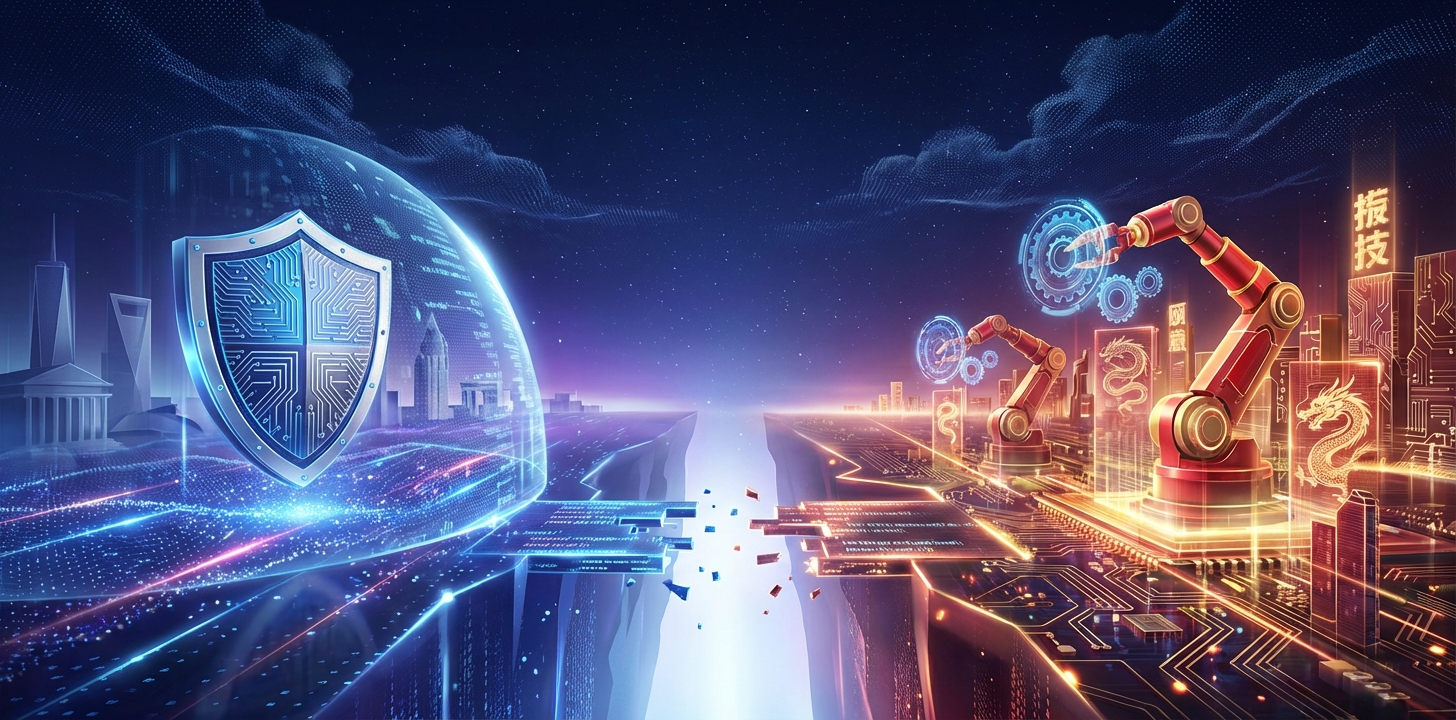
The world is splitting into "AI Blocs." We are seeing a "Digital Iron Curtain" descending. On one side, you have the US-led alliance (OpenAI, Google, Anthropic) focused on massive scale and high-cost, high-reward safety models. On the other, the Chinese ecosystem is focusing on agile, efficient, and widely distributed models.
The "Global Signal" here is that 2026 is the year of Sovereign AI. Countries are realizing they cannot rely on a foreign API for their national infrastructure. This is why we see the US government being briefed on Anthropic’s "Mythos" [9]. AI is now a matter of national defense, right up there with nuclear energy and cybersecurity.
Malaysia Watch
What does this mean for Malaysia? As a growing hub for data centers in Southeast Asia, Malaysia sits on a goldmine. The "gigawatt" requirements of companies like Anthropic and Google mean they are looking for places with stable energy and strategic locations.
- Data Center Boom: Malaysia’s investment in digital infrastructure is paying off. With the US and China looking for neutral ground to host regional data, Malaysia is perfectly positioned.
- The Talent Pivot: Local developers should stop trying to build "the next LLM" and start building "the next AI implementation." The opportunity in 2026 is in taking these massive models and applying them to local industries like palm oil optimization, Islamic finance, and regional logistics.
- Educational Shift: With AI agents becoming more capable, the Malaysian workforce needs to move away from "task-based" skills to "oversight-based" skills.
Fun Fact: Did you know that training a single state-of-the-art AI model in 2026 can consume more water for cooling than 50 Olympic-sized swimming pools? 🌊
What to Do Next
The landscape is shifting beneath our feet. Here is how you can stay ahead:
- Diversify Your AI Stack: Don't just rely on ChatGPT. Start experimenting with Anthropic’s Claude and Alibaba’s Qwen. Each has different strengths in reasoning vs. coding.
- Focus on "Agentic" Skills: Learn how to manage "AI Agents" (like those from Hermes or Openclaw) rather than just writing prompts. The future is about directing a team of AIs, not just talking to one.
- Audit Your Data Privacy: With the "United Front" fighting IP siphoning, expect stricter terms of service. Make sure your company's proprietary data isn't being used to train the very models you're paying for.
- Watch the Energy Sector: If you are an investor, the "AI play" isn't just in software anymore. It’s in energy, cooling systems, and specialized chips like Microsoft’s Maia [20].
TL;DR
- Massive Scale: Anthropic secures "gigawatts" of power and a $350B valuation, signaling a shift to industrial-scale AI.
- The United Front: Google, OpenAI, and Anthropic team up to prevent China from siphoning AI capabilities.
- Hardware Wars: Microsoft launches the Maia chip to challenge Nvidia; China counters with hyper-efficient models like DeepSeek.
- Bottom Line: 20
Found this article helpful? Share it with others!
Quick AI FAQ
How does this AI development affect Malaysian businesses?
Local businesses can leverage these AI breakthroughs to automate repetitive tasks, improve customer engagement via smart chatbots, and scale content production with 80% lower costs.
Is it safe to integrate AI into existing workflows?
Yes, when implemented with professional oversight. We focus on secure, privacy-compliant AI integrations that align with Malaysia's PDPA regulations.
Where can I get help with AI implementation in Penang?
JOeve Smart Solutions provides on-site and remote AI consultation for SMEs in Penang and across Malaysia, specializing in web apps, chatbots, and video automation.