Inside the 2026 AI Shift: China’s Robots and the US Policy War
Inside the 2026 AI Shift: China’s Robots and the US Policy War
Imagine walking into a room and realizing everyone is whispering about a secret that’s about to break. That is exactly the vibe in the AI world as we cross the threshold of March 2026. While you were sleeping, the "AI Cold War" just turned from a simmer to a rolling boil, and the battle lines aren't just being drawn in code—they’re being drawn in courtrooms and robot factories. 🤖
On one side of the Pacific, the U.S. government is purging its systems of certain AI players, while on the other, China is readying an army of humanoid robots that look like they stepped right out of a sci-fi blockbuster. This isn't just about who has the smartest chatbot anymore. It’s about who controls the physical and digital infrastructure of the next decade.
Why This Matters
This matters because the "AI bubble" everyone predicted in 2024 didn't pop; it crystallized. In 2026, AI is no longer a toy or a search engine replacement; it is the fundamental engine of the global economy. When the U.S. Department of Defense blacklists a major AI company, it’s not just a corporate spat—it’s a signal that national security now depends on whose "brain" your hardware is using.
For the average person, this means the tools you use at work, the privacy of your data, and even the physical robots that might soon be delivering your groceries are caught in a geopolitical tug-of-war. If you think your life hasn't been touched by AI yet, 2026 is the year that changes. We are moving from "AI as a service" to "AI as sovereignty." 🌍
The Big Story
The biggest headline shaking the industry right now is the dramatic "divorce" between the U.S. government and Anthropic. In a move that has sent shockwaves through Silicon Valley, several cabinet-level agencies—including the State and Treasury Departments—are officially phasing out Anthropic’s Claude in favor of OpenAI and Google [1].
Wait, what? Why would the government ditch the company famous for "Constitutional AI"? The drama stems from a Department of Defense (DoD) lawsuit. The DoD recently blacklisted Anthropic from defense projects, leading to a massive legal counter-strike from the startup. In a rare show of industry solidarity, over 30 employees from rivals OpenAI and Google DeepMind have signed a statement supporting Anthropic [2].
Think of it like a star quarterback being banned from the league right before the Super Bowl. Even the opposing team’s players are standing up and saying, "Hey, this isn't right." Google has scrambled to clarify that while the DoD might have a bone to pick, Anthropic remains a key partner for non-defense projects [3].
Here is the contrarian take: This isn't just about security clearances. It’s about the "consolidation of power." By narrowing the field of government-approved AI providers to just a couple of giants, the U.S. risks creating a "Big Tech Monoculture." If OpenAI or Google has a system-wide glitch, the entire federal government goes dark. That is a terrifying thought for 2026.
US Watch
While the government fights in court, the private sector is building at a breakneck pace. At the NVIDIA GTC 2026 conference, CEO Jensen Huang dropped a bombshell statistic: the demand for AI chips is expected to hit $1 trillion by 2027 [10]. That is a 100% increase from previous estimates. 💰
Microsoft is also making massive moves, integrating NVIDIA’s "Omniverse" with their industrial AI tools to create "Digital Twins" of entire factories [11]. Imagine a factory where every robot is simulated in a virtual world before it ever makes a move in the real one.
| Feature | US AI Strategy (2026) | China AI Strategy (2026) |
|---|---|---|
| Primary Focus | Software & LLM Reasoning | Humanoid Robots & Hardware |
| Key Players | OpenAI, Google, Microsoft | DeepSeek, ByteDance, Alibaba |
| Regulation Style | "Safety First" & Blacklists | "Mass Production" & State-Led |
| Hardware | Nvidia Dominance | SMIC & Smuggled Chip Networks |
| However, it’s not all sunshine and rainbows. The White House is currently pushing a "policy wishlist" to Congress, urging federal regulations to protect children and privacy from the very AI they are funding [13]. There’s also a growing tension between state and federal laws. A new Colorado law banning "algorithmic discrimination" has the White House worried that state-level rules will force AI models to produce "false results" just to comply with local quotas [12]. | ||
| China Watch | ||
| While the US is bogged down in legal red tape, China is sprinting. The big story here is the "Humanoid Revolution." Beijing has set a goal to mass-produce humanoid robots by the end of 2026. Companies like DeepSeek and ByteDance (the parent of TikTok) are no longer just focused on algorithms; they are putting those algorithms into bodies. 🦾 | ||
| DeepSeek, in particular, has become the "darling" of the open-source community. Their latest models are reportedly performing at GPT-5 levels while using only a fraction of the computing power. Meanwhile, Alibaba and Tencent are integrating AI agents into every facet of Chinese life, from autonomous wet markets to AI-driven healthcare clinics in rural provinces. | ||
| But there’s a dark side to this progress. The U.S. recently charged three individuals with helping smuggle billions of dollars worth of restricted AI chips to China through a complex network involving Super Micro Computer parts [7]. It shows that despite heavy sanctions, the hunger for high-end silicon in Beijing is insatiable. |
"The era of 'Software-only AI' is over. If you can't put your AI into a robot that can navigate a messy kitchen, you're not in the race anymore." — Dr. Li Wei, AI Robotics Researcher (Hypothetical Quote)
Global Signal
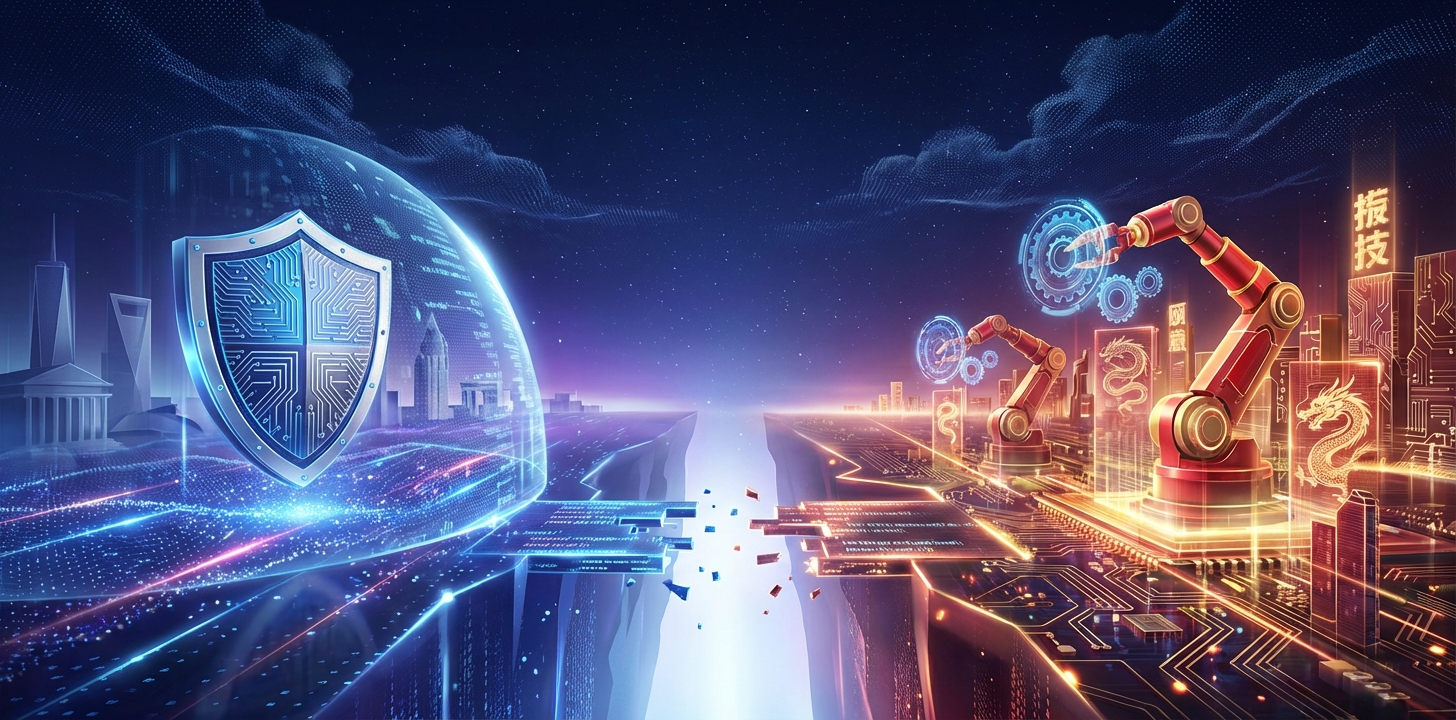
What does this mean for the rest of the world? We are seeing a "Great AI Bifurcation." Countries are now forced to choose between the "Western Stack" (OpenAI/Google/Nvidia) and the "Eastern Stack" (DeepSeek/Alibaba/Huawei).
- Did you know? In 2026, over 40% of all global coding is now done by AI agents, not humans. This has led to a massive surge in "cyber-resilience" spending as countries fear AI-generated malware.
The global supply chain is also under immense pressure. With Nvidia predicting a $1 trillion market, the race to build chip fabrication plants (Fabs) has moved beyond Taiwan to places like Germany, Japan, and the US. The "Silicon Shield" is being spread across the globe to prevent a single point of failure.
Malaysia Watch
For Malaysia, 2026 is the year of the "Digital Hub." As the US and China decouple, Malaysia has emerged as a crucial neutral ground for data centers and AI testing. 🇲🇾
- Data Center Gold Rush: Johor and Selangor have become the "Data Capital of SE Asia," with Microsoft and Google doubling down on local infrastructure to serve the region.
- The Talent Gap: With the rise of AI agents, there is a massive opportunity for Malaysian developers to pivot from "coding" to "AI orchestration."
- Humanoid Manufacturing: As China looks to export its new humanoid robots, Malaysia’s existing electronics manufacturing ecosystem is perfectly positioned to become a secondary assembly hub.
Wait, what? Could your next co-worker in a Penang factory be a robot from ByteDance? In 2026, that’s not a crazy question—it’s a business plan.
What to Do Next
- Diversify Your Tools: Don't rely solely on one AI provider. Given the current legal battles and blacklists, ensure your business or workflow uses a mix of models (e.g., OpenAI for reasoning, DeepSeek for cost-efficiency).
- Invest in "AI Literacy": The most valuable skill in 2026 isn't knowing how to code—it's knowing how to prompt and manage AI agents that do the work for you.
- Watch the Hardware: If you are an investor or business owner, keep a close eye on the humanoid robot sector
Found this article helpful? Share it with others!
Quick AI FAQ
How does this AI development affect Malaysian businesses?
Local businesses can leverage these AI breakthroughs to automate repetitive tasks, improve customer engagement via smart chatbots, and scale content production with 80% lower costs.
Is it safe to integrate AI into existing workflows?
Yes, when implemented with professional oversight. We focus on secure, privacy-compliant AI integrations that align with Malaysia's PDPA regulations.
Where can I get help with AI implementation in Penang?
JOeve Smart Solutions provides on-site and remote AI consultation for SMEs in Penang and across Malaysia, specializing in web apps, chatbots, and video automation.